M06 Direct Drive Motors for Compact Service Robot Wheel Modules
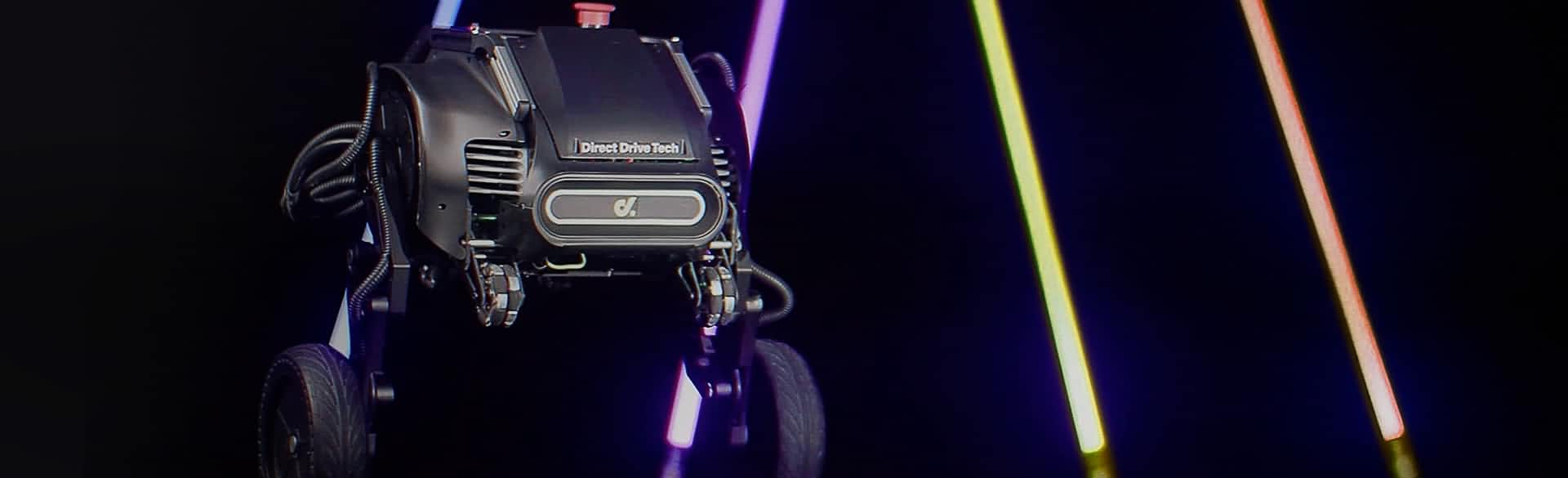
Direct Drive M06 motors are compact wheel-drive solutions designed for service robots that require high torque output, accurate motion control, and low mechanical complexity. Compared with geared wheel systems, they remove transmission parts and can improve efficiency, response speed, and operating noise. Modern direct-drive wheel modules can reach 85–95% efficiency, support continuous operation for thousands of hours, and fit robot platforms below 50 kg where installation space is limited.
Service robots used in hotels, hospitals, warehouses, and commercial buildings need wheel modules that combine strength and precision. Traditional geared motors often rely on planetary gear sets or harmonic reducers to increase torque, but these components add friction, backlash, and maintenance requirements. A direct-drive architecture places the motor rotor directly on the wheel axis, reducing mechanical transmission losses and improving control accuracy.
A direct-drive wheel module typically reduces the number of mechanical parts by 30–60% compared with a similar geared design, which can simplify assembly and reduce long-term maintenance requirements.
The M06 series belongs to this type of compact direct-drive solution. Direct Drive M06 motors are designed for small robotic platforms that require smooth movement and reliable operation. By connecting the motor directly to the wheel, the system avoids gear reduction stages and allows the controller to regulate torque output more accurately.
The motor structure usually uses a permanent magnet synchronous motor (PMSM) or brushless DC motor (BLDC) configuration. These motors generate torque through the interaction between permanent magnets on the rotor and electromagnetic fields in the stator. Without a gearbox, energy losses caused by gear contact, lubrication, and mechanical friction are reduced.
| Parameter | Typical Compact Direct Drive System |
|---|---|
| Motor efficiency | 85–95% |
| Operating voltage range | 24–48 V |
| Torque output | 5–20 Nm for small robots |
| Encoder resolution | 10,000+ counts/revolution |
| Robot payload range | 20–100 kg |
Torque performance determines whether a robot can start smoothly, climb ramps, and carry different payloads. A small indoor delivery robot weighing 30–50 kg may require wheel torque above 10 Nm during acceleration. Direct-drive motors provide this torque without relying on a mechanical reduction mechanism, allowing faster response when the robot changes speed or direction.
The absence of gears also improves motion accuracy. In mobile robots, wheel rotation data is used for navigation, localization, and path correction. Even small mechanical errors can accumulate during long operation periods. High-resolution encoders combined with direct-drive motors provide more accurate wheel-speed feedback.
In autonomous mobile robots, encoder feedback accuracy and motor control quality directly influence navigation performance, especially during repeated turning and positioning tasks.
Noise performance is another important factor for indoor robots. Gear systems create sound through tooth contact, vibration, and mechanical resonance. Direct-drive motors generate torque through electromagnetic interaction, reducing mechanical noise sources. Many indoor service robots operate below approximately 50–60 dB, making them suitable for offices, healthcare facilities, and hospitality environments.
Thermal design remains an important engineering consideration because direct-drive motors produce all required torque from the motor itself. A compact motor housing must remove heat generated by copper losses, iron losses, and power electronics. Aluminum housings, optimized stator structures, and improved heat-transfer materials are commonly used to maintain stable performance.
The motor controller also affects overall wheel-module performance. Modern systems often use field-oriented control (FOC) to regulate current and magnetic fields. FOC allows smooth torque production at different speeds and reduces vibration during acceleration and braking. Since the early adoption of FOC-based motor controllers in industrial robotics around the 2000s, the technology has become common in compact autonomous platforms.
Direct-drive wheel modules provide advantages in reliability because they contain fewer mechanical wear components. Gear teeth, lubrication systems, and transmission bearings are common maintenance points in traditional motor assemblies. Removing these parts can extend service intervals, especially for robots operating 8–16 hours per day.
A comparison between traditional geared wheel modules and direct-drive designs shows differences in system structure:
| Feature | Geared Wheel Motor | Direct Drive Wheel Motor |
|---|---|---|
| Transmission parts | Multiple gears | No reduction gear |
| Mechanical efficiency | 70–85% | 85–95% |
| Noise level | Higher | Lower |
| Backlash | Possible | Minimal |
| Maintenance | More components | Simplified structure |
Compact robot design also benefits from modular wheel integration. A complete wheel module containing the motor, encoder, and mounting interface can be installed as a single unit. This approach allows robot manufacturers to develop different platforms using similar mobility components, reducing engineering time and improving production consistency.
Applications for direct-drive wheel modules continue expanding. In logistics robots, accurate movement helps robots navigate narrow warehouse aisles. In healthcare environments, quiet operation is important because robots may work near patients and staff. In hospitality settings, smooth acceleration and compact dimensions improve interaction with users.
A service robot operating continuously for 10 hours per day may complete more than 3,000 operating hours per year, making motor reliability an important design requirement.
The selection of a direct-drive motor depends on several parameters, including robot weight, wheel diameter, speed requirement, battery capacity, and operating surface. Larger wheels improve obstacle handling but require higher torque. Higher speeds improve transportation efficiency but may reduce available torque. Engineers normally balance these factors according to the robot’s intended environment.
The M06 direct-drive platform is suitable for applications where compact size and accurate movement are required. Compared with traditional motor-and-gear assemblies, it provides a simpler mechanical structure, lower noise, and faster torque response. As service robots become more common after 2020, direct-drive technology has become increasingly used in small autonomous mobility systems that require stable operation and precise control.